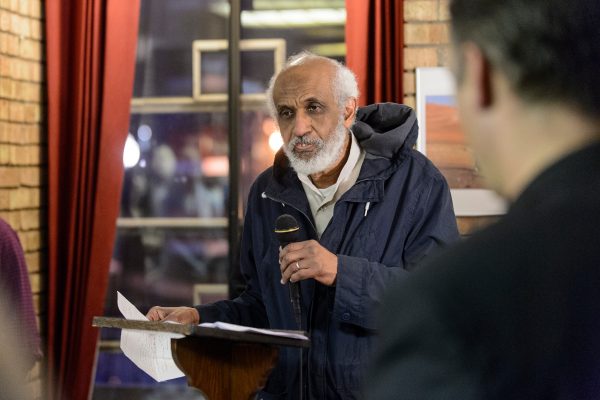
 After decades of dedicated teaching, mentorship, and service to the Department of African Cultural Studies at the University of Wisconsin–Madison, Arabic Instructor Mustafa Mustafa is retiring, leaving behind a lasting impact on generations of students and colleagues alike. In recognition of this extraordinary record, the Department’s Executive Committee voted unanimously on April 23, 2026, to recommend that he be granted emerit status — a reflection of both his excellence and his irreplaceable contributions to the university community.
Known affectionately by many students as “Ustadh (Professor) Mustafa,” he has been a cornerstone of UW–Madison’s Arabic language program since joining the department in the early 1990s. According to departmental records, he formally joined as an Assistant Faculty Associate in fall 2008, later retitled Teaching Faculty II in 2021. Throughout his career, he has combined rigorous language instruction with warmth, humor, and an unwavering commitment to student growth.
UW-Madison African Cultural Studies Department Chair Luís Madureira emphasizes the depth and longevity of Mustafa’s contributions, noting that “for the past two decades, Mustafa has been the heart of our Arabic language program.” He adds that “his teaching, his mentorship, and his presence have shaped the experience of countless students.”
Professor Emeritus Dustin Cowell, a longtime colleague and friend, reflected on Mustafa’s decades of impact on the department, also describing him as a foundational presence within UW–Madison’s Arabic program.
Cowell highlights the depth of Mustafa’s academic grounding, particularly his knowledge of the Arabic language’s historical development and classical traditions.
“You bring deep knowledge of the history of the Arabic language, along with a strong understanding of the classical traditions that continue to shape how we teach Arabic today. Your familiarity with Islamic texts has given you a unique insight into how the language has developed and endured over the centuries.”
Madureira echoes this, noting that “Mustafa brings a profound and erudite familiarity with the history of the Arabic language into the classroom, enriched by a wide-ranging knowledge of the classical traditions that continue to define Arabic instruction.”
This foundation has allowed Mustafa to bring historical and textual depth into the classroom, enriching how students understand Arabic not just as a modern communicative tool, but as a language with long-standing intellectual and cultural traditions.
At the same time, Cowell emphasizes Mustafa’s ability to evolve as a teacher and adapt to modern pedagogical approaches. As Modern Standard Arabic instruction shifted toward more communicative and student-centered methods, Mustafa embraced these changes while maintaining rigor and clarity:
“As a teacher of Modern Standard Arabic, you have continually adapted your approach, embracing modern methods of language pedagogy. Your teaching has evolved to reflect a student-centered, communicative style that has long been valued in our department.”
In practice, this meant designing meaningful classroom activities that built both confidence and competence. Students were encouraged to speak and write actively in Arabic, while also developing a deeper cultural understanding of the Arabic-speaking world. Rather than relying solely on rule-based instruction, Mustafa emphasized language use, creativity, and engagement.
“For many years,” Madureira explains, “he invested immense time and thought into designing meaningful activities that helped students grow more confident in speaking and writing, while deepening their understanding of Arabic-speaking cultures.”
For many students, this balance—between rigor and encouragement, between high expectations and genuine support—defined their experience in the program. It is also reflected clearly in student testimonials, which speak not only to Mustafa’s instruction but to his presence as a mentor and personality in the classroom.
One student, Aaleeyah Padela, writes:
“Ustadh Mustafa is one of the most genuine and kind teachers I have ever had in my life. He is also extremely witty and caring, and having class with him almost every morning for the past year has always been a bright start to my day. He is an absolute gem, and I am extremely grateful for everything he has done for me and everything I have learned from him. I will truly miss him, but I wish him the best in his retirement!”
Another student, Michael McPhee, captures the intensity and structure of Mustafa’s classroom:
“Ustadh has the highest expectations of any professor I have had at UW-Madison. Every day I come to class knowing that I am going to be pushed to work harder, learn more, and continue to grow. Ustadh Mustafa is not for everybody, and that is what makes him so special. He comes into class shouting ‘Arabic only!’, but he ends it with a pat on the shoulder and a see you tomorrow that makes you more excited to come back the next day. I would not want to learn Arabic from anyone except him. Enjoy retirement Ustadh, you deserve every minute of it.”
Other students echo similar sentiments, balancing humor, affection, and gratitude:
“Professor Mustafa is such a joy— so silly and makes me laugh every class. I am so glad I had the pleasure of being his student.”
— Sama Alzein“Thank you for all you do— even the yelling. My Arabic has improved more than I could have ever imagined under your teaching.”
— Hunter Vierck“Professor Mustafa is a serious yet fun teacher. His dedication to the Arabic language helped me through the Arabic semesters and deepened my interest in the learning the language.”
— Rawan AlBahadli
Taken together, these reflections illustrate a teacher who is remembered not only for academic rigor, but for presence, personality, and care—someone who shaped daily classroom experience into something students looked forward to, even when it challenged them.
Beyond the academic year, Mustafa’s impact extended into intensive summer language learning environments. Between 2006 and 2016, he taught in the Arabic, Persian, and Turkish Immersion Institute and the Arabic and Persian Immersion Program, contributing significantly to their continuity and effectiveness.
Since 2016, Mustafa has also served as the Acting Director of Baytunaa, the Arabic Language House in the International Learning Community. In this role, he taught a one‑credit course on “Popular Expression in the Arab World” through spring 2025 and mentored both graduate student instructors and Fulbright Language Teaching Assistants. His leadership helped cultivate a vibrant residential learning community and strengthened the department’s broader pedagogical ecosystem.
Madureira underscores the importance of this work: “Mustafa has mentored and supported our graduate student instructors and Fulbright Language Teaching Assistants in ways that have had a lasting impact on their development as teachers.”
Throughout his twenty years at the University of Wisconsin, Mustafa has also been an excellent citizen, serving on departmental committees and continually refining his teaching skills. As Madureira writes, “no list of accomplishments can capture the moments when a student tells me they fell in love with Arabic after taking a class with Mustafa, or when a doctoral student credits their success as a teacher to his mentoring. Those moments define the distinctiveness of his impact.”
He adds, “His influence has been so profound that it will be very hard, if not impossible, to replace him.”
Retirement, in this context, is not an ending so much as a transition away from a daily institutional role that has already left a lasting imprint. The Arabic program at UW–Madison carries forward the structures, expectations, and spirit shaped in part by Mustafa’s decades of teaching.
For that enduring contribution, the Department of African Cultural Studies extends its deepest gratitude to Mustafa Mustafa for his remarkable service as a teacher, mentor, colleague, and community builder. His legacy will continue to shape the program for years to come, even as he steps into a well‑deserved and joyful retirement.